Every café, salon and store owner knows the feeling. A new customer walks in, enjoys the visit, says they will be back, and then you never see them again. Not because the experience was bad, but because nothing gave them a reason to choose you over the ten other places on the same street. App loyalty programs exist to solve exactly this problem. They turn a single good visit into a habit.
In this guide we look at why repeat visits matter so much for local businesses in India, how app loyalty programs increase repeat visits in practice, and how to design a reward that brings customers back without hurting your margins.
Why repeat visits matter more than new footfall
Most local businesses spend their marketing effort on getting new people through the door: flyers, discounts for first-timers, social media posts. New footfall matters, but regulars are where the profit is.
- Regulars cost less to serve. You have already paid to win them once. Every return visit comes without a fresh acquisition cost.
- Regulars spend with confidence. A customer who trusts your food, service or products is more willing to try something new or order a little more.
- Regulars bring others. Word of mouth from a loyal customer is still the most trusted recommendation a local business can get.
Research by Frederick Reichheld of Bain & Company, widely quoted in retail, found that even a small improvement in customer retention can lift profits sharply. You do not need the exact figure to see the logic: a business that keeps its customers grows on a steady base, while a business that keeps losing them has to start from zero every month.
What is an app loyalty program?
An app loyalty program rewards customers for coming back, and it lives on the customer's phone instead of on a paper card. Each visit or purchase is recorded automatically, progress towards the next reward is visible at a glance, and rewards can be redeemed at the counter in seconds.
Here is how it compares with the stamp or punch card that many shops still use:
| What matters | Paper punch card | App loyalty program |
|---|---|---|
| Carrying it | Easy to forget or lose | Always on the customer's phone |
| Tracking visits | Manual stamps, easy to fake | Recorded automatically and fairly |
| Seeing progress | Only when the card is out | Visible any time in the app |
| Bringing people back | Relies on the customer remembering | Timely reminders and new offers |
| Learning what works | No data at all | Clear view of which offers drive return visits |
How app loyalty programs increase repeat visits
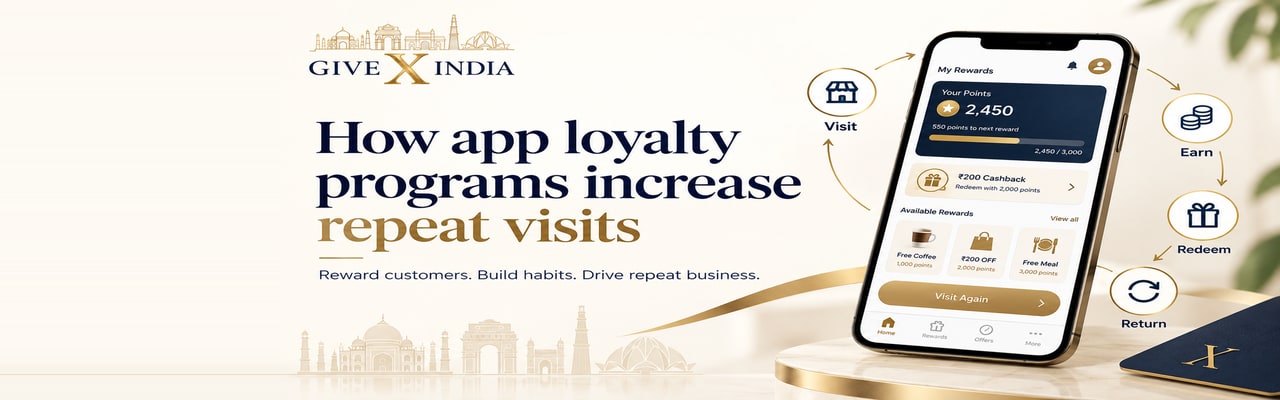
A good loyalty program runs on a simple loop. The customer visits, earns something for that visit, redeems it, and returns to earn again. Each turn of the loop makes the next visit more likely. Here is what drives it.
1. The reward is always in the customer's pocket
The biggest weakness of a paper card is that it sits at home in a drawer when the customer is deciding where to eat or shop. When the reward lives in an app on their phone, it is right there at the moment of decision. A customer choosing between two similar cafés will usually pick the one where they are already close to a free coffee.
2. Visible progress pulls customers forward
People are motivated by goals they can see. Behavioural research on coffee-shop reward cards found that customers tend to visit more often as they get closer to a reward, an idea known as the goal-gradient effect. An app makes that progress impossible to miss: "550 points to your next reward" is a small, clear nudge to come back soon.
3. Timely reminders bring lapsed customers back
Customers rarely leave because they dislike you. They simply forget. An app can send a gentle reminder when a reward is about to unlock, when an offer is running this week, or when someone has not visited in a while. It is far less intrusive than a phone call, and far more effective than hoping they remember.
4. Instant redemption feels rewarding
A reward that is hard to claim is not a reward at all. When redemption takes a few seconds at the counter, with no forms and no arguments about a missing stamp, the customer leaves with a good feeling. That positive last impression is what brings them back.
5. Offers can match how each customer shops
A family that visits on weekends and an office worker who drops in for a quick lunch want different things. App loyalty programs let you shape offers around real behaviour, such as a weekday lunch deal or a weekend family offer, so the reward feels relevant instead of generic.
6. You can see what actually works
With paper cards, you never know which promotion brought people back. An app shows you which offers are redeemed, how often customers return and when your quiet hours are. You can drop the offers that do nothing and double down on the ones that fill your tables and counters.
Types of loyalty rewards that work for local businesses
There is no single best reward. Choose the format that suits your business and your customers:
- Points per spend: customers earn points on every bill and redeem them for a discount or a free item. Works well for stores and restaurants with varied bill sizes.
- Visit-based rewards: for example, a free coffee on the sixth visit. Simple to understand and ideal for cafés, bakeries and salons.
- Instant discounts or cashback: a clear saving on the current bill. Great for winning the first visit and making the second one easy.
- Tiered rewards: regulars unlock better benefits as they visit more. Your best customers feel recognised.
- Quiet-hour offers: a reward that only applies on slow days or times. Brings footfall exactly when you need it.
How to design a loyalty offer that brings customers back
A loyalty program only works if the offer makes sense to the customer and to your margins. Follow these steps:
- Pick one clear goal. Do you want more weekday visits, bigger bills, or more first-timers becoming regulars? Design the offer around that goal.
- Make the first reward reachable. If the first reward feels too far away, customers give up. An early win builds the habit.
- Protect your margins. Set a minimum bill and a maximum discount so every redemption is still profitable for you.
- Keep the rules simple. If you cannot explain the offer in one sentence, it is too complicated.
- Use your quiet hours. Point your best offers at the times you usually have empty tables or an idle counter.
- Review and adjust monthly. Look at what gets redeemed and what does not, then refine.
Common mistakes to avoid
- Rewards that are too small to notice. A token discount does not change anyone's behaviour.
- Rewards that are too generous. If every visit loses money, the program will not last.
- Complicated conditions. Hidden exclusions and fine print make customers feel tricked.
- Staff who do not know the offer. A confused team at the counter ruins the experience. Brief everyone.
- Setting it and forgetting it. Offers go stale. Refresh them to keep customers interested.
How Give X India helps you win repeat visits
Give X India connects local restaurants, cafés, bars and retail stores with members who are already browsing for offers near them. Instead of chasing strangers with flyers or cold calls, your offer appears in front of people with local intent, right when they are deciding where to go.
- You set the offer. Choose the discount, the minimum bill and the maximum discount, so every deal fits your margins. You can change it at any time.
- You reach nearby members. Members browsing offers on Give X India discover your business when they are looking for a place nearby.
- You stand out as verified. A verified merchant badge tells new customers you are a real, trusted local business.
- You manage everything in one place. A simple dashboard lets you manage your listing, offer and details.
A fair offer brings a member in for the first time. A good experience plus that same fair offer gives them a reason to return, and that is how first visits turn into regulars.
Getting started is free. Listing your business and submitting your application cost nothing, and there are no hidden commissions. You only ever give the discount you choose. Most applications are reviewed within 1–2 business days. List your business on Give X India.
Want the customer's side of loyalty too? Read why voucher codes drive customer loyalty in the digital era.
Key takeaways
- Repeat customers are cheaper to serve and more valuable than one-time footfall.
- App loyalty programs work because the reward is always on the customer's phone, progress is visible, and reminders arrive at the right time.
- The best offers are simple, reachable and protected by a minimum bill and a maximum discount.
- Measure what gets redeemed and adjust every month.
- With Give X India, you control the offer, reach nearby members and turn first visits into regular business.